

Quick Summary
Professional automotive fillers are sold by specialist auto body suppliers, dedicated body shop retailers, general marketplaces, and auto parts stores with local pickup. Specialist suppliers usually offer the widest professional-grade range and business accounts, while marketplaces offer fast price comparison.
- Specialist auto body suppliers often offer professional accounts and one-stop refinish supply.
- Compare delivered cost per usable quantity, not the listed price.
- Confirm the hardener is included, since it is sold separately in many catalogs.
- Check mix ratio, working time, shelf life and substrate compatibility on the data sheet.
- Auto parts stores with local pickup suit urgent jobs where shipping is too slow.
Table of Contents
- Where Professionals Buy Automotive Fillers and Why It Matters
- Quick Comparison of Filler Sources and Typical Listed Prices
- Specialist Auto Body Suppliers and Dedicated Retailers
- Marketplaces and Auto Parts Stores for Local Pickup
- Choosing Filler by Repair Material, Job Size, and Container
- How to Pick the Best Automotive Body Filler for Your Shop
- Total Cost, Shipping, and Verifying Product Quality Before You Order
- Setting Up Your Next Supply Order With Speedokote
- Frequently Asked Questions
Where Professionals Buy Automotive Fillers and Why It Matters
Last Updated: November 12, 2026
Professional body shops buy automotive fillers from specialist suppliers, distributors and marketplaces, and the choice of source affects cost, lead time and what you actually receive. The U.S. automotive body filler market was valued at USD 1.41 billion in 2026, according to Business Research Insights market valuation report, and that demand is spread across many suppliers. For a shop, finding a reliable source matters as much as finding a good product.
This guide from Speedokote, a mobile refinish and bodyshop supply company, walks through where professional automotive fillers are sold and how to choose between them. We also cover filler types, container sizes and how to check quality before you order.
Quick Comparison of Filler Sources and Typical Listed Prices
Professional buyers generally choose between four source types: specialist auto body suppliers, dedicated auto body retailers, general marketplaces, and auto parts stores with local pickup. Each differs in product range, pricing transparency, shipping terms, return policy, and whether the seller offers a professional or business account.
| Source Type | Example Listed Price | Product Range | Shipping and Returns | Professional Account | Best For |
|---|---|---|---|---|---|
| Specialist auto body supplier | Quote-based; varies by product and quantity | Deep professional-grade lines, primers, and spray equipment | Shipping quoted per order; confirm return window before ordering | Often available on request | Shops that want one supplier across refinishing categories |
| Dedicated auto body retailer | High Teck Lightweight Body Filler, 0.8 gallon: $28.95; cream hardener: $8.95; CARWORX FIBERWORX Filler: $36.95 | Shop-size containers with public prices | Shipping calculated at checkout; return policy posted per item | Limited; check for trade pricing | Budgeting with visible prices |
| Specialty plastic filler listing | CARWORX FLEX FILLER for plastic: $34.95 | Narrow, material-specific | Confirm package size and shipping before ordering | Usually not offered | Plastic bumper and flexible panel repair |
| Marketplace | Varies by listing; many items ship free | Very broad, mixed quality | Free shipping common but seller terms vary; returns depend on seller | Rarely offered | Fast price comparison across many sellers |
| Auto parts store with local pickup | Kits reported to start under $20 | Consumer and prosumer brands such as Bondo and Evercoat | In-store pickup; return policy set by the chain | Some chains offer commercial accounts | Urgent jobs where pickup beats shipping |
Pricing for Speedokote's own products depends on quantity, order date and delivery, so request a current quote before you budget.
A common pattern among shops is to split purchasing: a specialist supplier for the fillers used weekly, a marketplace for one-off specialty items, and a local store for emergency top-ups. That split keeps lead time short without tying up cash in slow-moving stock.
Watch out: a marketplace listing that shows free shipping can still cost more per usable gallon once you account for a missing hardener or a smaller package size, so compare delivered cost per usable quantity rather than sticker price.
Specialist Auto Body Suppliers and Dedicated Retailers
Specialist suppliers are usually the first choice for shops that need consistent product lines and knowledgeable support. Their catalogs tend to be organized by repair material, which makes it easier to match a filler to the job.
A dedicated auto body retailer such as TP Tools lists products by category. A listing rarely shows full technical specifications, so confirm details before you buy.
Speedokote operates as a mobile refinish and bodyshop supply company with a range of fillers, primers and spray equipment. Contact Speedokote directly for current stock and pricing.
Marketplaces and Auto Parts Stores for Local Pickup
Marketplaces such as eBay and Amazon carry large numbers of body filler and putty listings from many sellers. That breadth helps when you want to compare options quickly. It also means quality and packaging vary, so read each listing carefully.
Marketplace category pages can show many sellers, but they do not confirm that a product is suited to professional use, so check the manufacturer's data sheet.
Auto parts retailers often carry body filler kits, and local pickup can help when a job is urgent. Individual kit prices and features should be checked in store or online.
Choosing Filler by Repair Material, Job Size, and Container
The right filler depends on the material you are repairing and how much you need. A lightweight filler suits general dents and low spots on steel panels. A plastic-specific filler is designed for flexible surfaces such as bumpers. Fiber-reinforced fillers are typically used for larger repairs where extra strength matters.
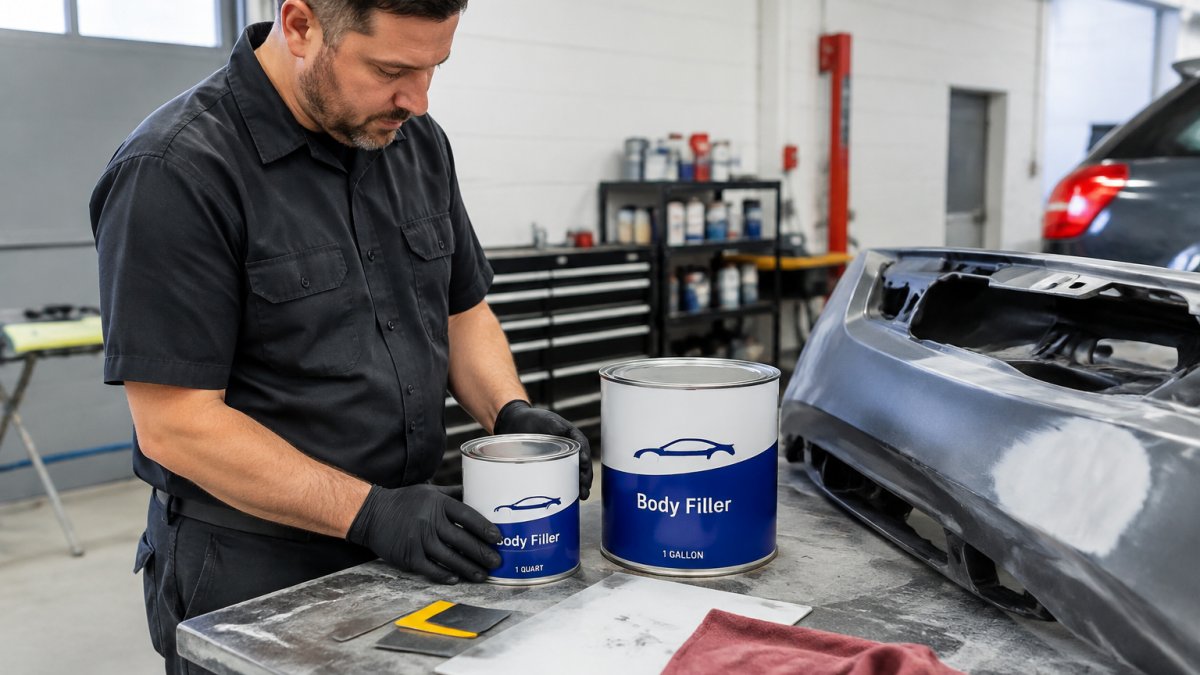
Container size affects both cost per use and waste. A 0.8-gallon container suits shops that repair several panels a week, while smaller quantities reduce the risk of product hardening before it is used. Cream hardeners are sold separately in many catalogs, so confirm you have the right hardener for your filler.
How to Pick the Best Automotive Body Filler for Your Shop
Start with three questions: what material are you repairing, how large is the repair, and how fast do you need to work? Those answers narrow the field quickly. Then compare workability and sandability, since both affect how much time each repair takes.
Industry guidance for 2026 emphasizes workability and sandability when selecting professional-grade fillers, as noted by Auto Premium Supply professional body filler guide. Compare fillers on those criteria instead of price alone. A cheaper product that sands poorly can cost more in labor.
Shops buying filler in larger container sizes should confirm the container matches their usage rate.
Filler thickness does not directly reflect how wide a repair is. Experts note that thick application does not always signal poor technique, so measure depth with proper tools instead of judging by appearance, as discussed by Linear Blocking Tools repair guidance.
Total Cost, Shipping, and Verifying Product Quality Before You Order
Total cost is not the listed price. Build the number from four parts: product price, shipping and handling, any minimum order or small-order fee, and the cost of a hardener if it is sold separately. Divide the delivered cost by the usable quantity, not the container size, to get a true cost per usable unit. A 0.8-gallon container and a 1-gallon container are not directly comparable if one includes hardener and the other does not.
Bulk and repeat purchasing change the math. Ask each supplier three questions before you commit: Is there a minimum order? Is there a price break at a case or pallet quantity? Is there a business or professional account with net terms? Specialist suppliers are more likely to answer all three; marketplaces usually answer none.
Quality verification is where most buyers leave money on the table. Before ordering, request or download the manufacturer's technical data sheet and confirm the following:
- Product identity and grade. Confirm the listing is the professional-grade version, not a consumer retail package with the same brand name.
- Mix ratio and hardener. Check the stated ratio by weight or volume and whether the hardener is included, sold separately, or supplied in a different size.
- Working and sanding times. These determine how much of a panel a technician can coat before the product kicks, and they vary by temperature.
- Shelf life and storage. Confirm the manufacture or batch date and the stated storage temperature range; filler that has been stored hot or frozen may not cure correctly.
- Substrate compatibility. Verify the data sheet lists steel, aluminum, plastic, or fiberglass as appropriate, and whether a specific primer or adhesion promoter is required.
- Safety documentation. Confirm a current safety data sheet is available and that the product labeling matches the documentation.
A practical pattern is to keep a folder of data sheets for every filler a shop stocks, so a technician can confirm mix ratio and substrate compatibility without hunting through a retailer listing. When a supplier cannot produce a current data sheet or a batch date, treat that as a signal about how the product has been stored.
Watch out: buying a general-purpose filler for a flexible plastic bumper can cause adhesion problems that only appear after paint, so confirm substrate compatibility on the data sheet before the order ships, not after.
Contact Speedokote to ask about product grade, hardener inclusion, and current stock before you place an order.
Setting Up Your Next Supply Order With Speedokote
Build your next order around the materials you repair most often, then add a plastic-specific filler and a hardener if your work requires them. Compare delivered prices, not just listed prices, and confirm container sizes before checkout. A short list of trusted suppliers saves time when a job is urgent.
Speedokote supplies fillers, primers and spray equipment for mobile refinishers and bodyshops. Contact us for current pricing and a quote for your next order, and join our mailing list for updates.
BUTTON: Request a Filler Quote
Frequently Asked Questions
Where can I buy professional automotive fillers online?
Professional automotive fillers are sold through specialist auto body suppliers, dedicated auto body tool retailers, and online marketplaces. Specialist suppliers typically list product types such as lightweight fillers, plastic-specific fillers, and cream hardeners by category, which makes it easier to match a product to the repair. Marketplaces offer wider selection and multiple sellers, but pricing, condition, and shipping vary by listing. For current prices and availability, check the supplier's website or request a quote, since pricing depends on quantity, dates, and delivery.
Can I buy professional auto body filler at an auto parts store?
Many auto parts stores carry body filler kits, usually aimed at consumer-friendly use. Shops that need specific plastic-repair fillers, fiber-reinforced products, or larger containers may find a better selection from a specialist body shop supplier. Calling the store ahead to confirm stock is a practical step for same-day repairs.
What is the difference between body filler and finishing putty?
Body filler is a heavier material used to fill larger dents and body imperfections, while finishing putty is a finer product used for smoothing small pinholes and final surface refinements. Using the wrong product often leads to sanding problems or poor adhesion. Check each product's listed application before ordering, especially when buying from a marketplace where listing details can be limited.
What should I look for when choosing an automotive body filler?
Consider the repair material, the size of the damage, and the sanding behavior you need. Lightweight fillers suit general dent work, while fiber-reinforced and plastic-specific fillers suit structural or flexible repairs. Container size matters for shop use, since a gallon can be more economical for frequent work. Verify technical details such as workability and sandability on the product listing or data sheet, and avoid assuming that a thicker application means a better result.
