
Last Updated: November 10, 2026
Quick Summary
Professional paint repair for collision centers follows five stages: damage assessment, surface preparation, primer application, base coat and clear coat application, and curing and quality inspection. Each stage has pass/fail criteria, and skipping any one pushes defects downstream where they cost far more to fix.
- Most paint failures trace back to surface preparation, not the product in the gun.
- Pull the paint code, then verify the variant against the actual vehicle before spraying.
- Blend color across a several-inch window positioned away from body lines and character lines.
- Set fluid tip size, air pressure, and fan pattern to manufacturer spec and verify with a test pattern.
- More than 70% of cars are projected to need calibration after collision repair by 2028.
Table of Contents
- Why Professional Paint Repair for Collision Centers Demands a Repeatable Process
- The Collision Center Paint Repair Process, Step by Step
- Automotive Paint Matching and Blending Across Panels
- Professional Automotive Spray Equipment and Booth Standards
- How Long Does Professional Automotive Paint Repair Take?
- Stocking Your Shop With Refinish Supplies That Hold Up
- Frequently Asked Questions
Why Professional Paint Repair for Collision Centers Demands a Repeatable Process
The U.S. auto body industry generates $67.7 billion in annual revenue, according to IBISWorld's Auto Body Shops in the US Industry Analysis, and every dollar of it depends on one thing: whether the finish holds up after the customer drives away. At Speedokote, we supply refinish products to shops that cannot afford comebacks, and the pattern is clear. Professional paint repair for collision centers is not a talent contest. It is a process problem.
Repair complexity has climbed by more than 30% over the past decade, per Business Research Insights' automotive collision repair market report. Advanced substrates, tighter panel gaps, and calibration requirements mean a painter who improvises on Monday and freewheels on Tuesday will produce two different results on two identical jobs.
What Separates a Factory Finish From a Rework
Factory finish is applied under controlled conditions with verified film build. A rework is what happens when a shop skips a step and hopes nobody notices. The difference usually shows up as peeling paint, poor color matching, or a clear coat that fails within a season.
The honest truth: most paint failures we hear about trace back to surface preparation, not the product in the gun.
The Collision Center Paint Repair Process, Step by Step
A collision center paint repair process follows five stages: damage assessment, surface preparation, primer application, base coat and clear coat application, and curing and quality inspection. Each stage has pass/fail criteria, and skipping any one of them pushes defects downstream where they cost far more to fix.
Surface Preparation and Primer
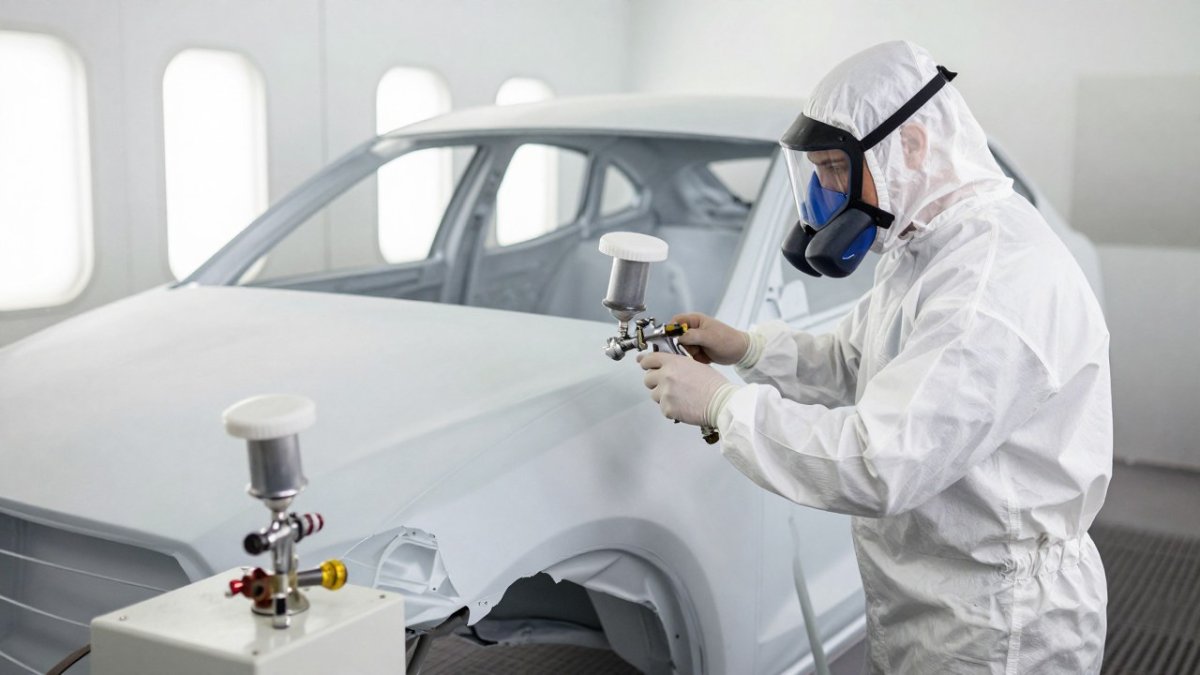
Surface preparation decides the outcome. Technicians sand to the correct grit, feather edges, clean with a proper prep wipe, and apply primer within the product's recoat window. A common mistake is rushing the flash time between primer coats. In practice, that shortcut shows up months later as solvent pop or adhesion loss.
Base Coat, Clear Coat, and Curing
Base coat lays down color; clear coat protects it. Apply base in thin, even passes until full hiding is reached, then let it flash before clear. Clear-coat application demands a wet, uniform film, and curing follows the manufacturer's temperature and time spec.
Here are the five stages every collision center paint repair should follow, each with its own pass/fail criteria.
| Stage | What happens | Key point |
|---|---|---|
| Damage assessment | Evaluate the repair before work begins | Skipping a stage pushes defects downstream |
| Surface preparation | Sand to correct grit, feather edges, prep wipe | Most paint failures trace back to prep |
| Primer application | Apply primer within the product's recoat window | Rushing flash time causes solvent pop or adhesion loss |
| Base coat and clear coat | Thin, even base passes; wet, uniform clear film | Let base flash before clear |
| Curing and quality inspection | Follow manufacturer's temperature and time spec | Finish quality is a measurement, not an opinion |
Automotive Paint Matching and Blending Across Panels
Paint matching is the step customers judge first, and it is the step most shops explain least. A professional match is not a single decision, it is a sequence of checks that starts with the vehicle identification label and ends with a technician inspecting the panel under the same lighting the customer will see it in.
Start With the Code, Then Verify the Variant
Every vehicle carries a paint code, usually on a service-parts label in the door jamb, under the hood, or in the spare-tire well. The code identifies the factory color, but most OEM colors ship in multiple variants because the same code was produced at different assembly plants or reformulated across model years. A competent technician pulls the code, then checks the variant chips or camera-based color retrieval against the actual vehicle.
Test Sprays and Tinting to the Vehicle
Before a gun touches the repair, the technician sprays a test card, often called a spray-out, and compares it to a cleaned, polished section of the adjacent panel. Sun exposure fades panels at different rates, so a code-perfect mix can still read too dark on a ten-year-old hood. From there the technician tints: adding toner in small increments until the spray-out disappears against the vehicle.
How Blending Actually Works
A hard color break at a panel seam is the most visible sign of a repair, so technicians blend instead of butting the new color against the old.
Watch out: blending into a panel that already has failing clear coat or a previous blend will lift or mottle the old finish, and no amount of color accuracy will save it, the adjacent panel has to be evaluated before the blend window is chosen.
Verifying the Match Before Delivery
A match is confirmed, not assumed. Technicians inspect the finished panel under daylight-balanced booth lighting and again under natural light, checking from multiple angles because metallic and pearl colors shift with viewing angle. A color that matches head-on but flops wrong at 45 degrees is still a mismatch. Documenting the variant, the tint formula, and the blend window on the repair order also gives the shop a record to work from if the customer returns, and gives the next technician a starting point instead of a guess.
Professional Automotive Spray Equipment and Booth Standards
A collision center's finish quality is capped by its equipment and its booth, not by the painter's wrist. Two shops can use the same primer and clear coat and produce different results because one controls air, temperature, and contamination and the other does not. This is the part of the process customers never see and shops rarely explain.
Spray Guns: Setup Determines Atomization
A spray gun breaks liquid paint into a mist, and the size and consistency of that mist, atomization, decides whether the finish lays flat or dries with a rough, sandy texture. Three settings drive it: fluid tip size, air pressure at the gun, and fan pattern. A primer may call for a larger fluid tip than a base coat; a clear coat may need a different pressure than the product next to it on the shelf.
Booth Types and What They Control
A professional booth does four jobs: it keeps dust off the wet film, it moves air at a controlled rate, it holds temperature, and it manages overspray. Cross-draft booths move air horizontally and are common in smaller shops; downdraft booths pull air from the ceiling through the floor and generally give better contamination control. Either type depends on intake filtration and exhaust filters being changed on schedule, a booth with loaded filters loses airflow and the finish suffers before anyone notices the gauge. Booth lighting matters too: daylight-balanced lamps let a technician see color and defect the way the customer will.
Curing Systems and Film Build
Curing is a chemical event, not just drying. The U.S. EPA's Collision Repair Campaign is a voluntary effort to reduce exposure to toxic air emissions from collision shops, and it reflects the same reality the booth is built around: refinishing involves real chemical exposure, and ventilation, respirators, and filtration protect both the painter and the finish.
Watch out: a booth that passes a visual inspection can still be out of spec on airflow or temperature, and a shop that skips filter changes and cure-time checks will chase defects it blames on product when the equipment is the cause.
How Long Does Professional Automotive Paint Repair Take?
Repair timing varies with parts availability, drying and curing time, blend area, and whether calibration is required after reassembly.
Watch out: promising a customer a one-day turnaround on a blend job is how shops create rework.
More than 70% of cars on the road are projected to need some form of calibration after collision repair by 2028, according to BodyShop Business reporting on industry surveys.
Stocking Your Shop With Refinish Supplies That Hold Up
Consistent results require consistent materials. A two-year follow-up study on collision shop safety practices found that improvements in small shops only held when the underlying practices were sustained, and materials discipline works the same way.
That is where Speedokote fits. Our inventory includes fillers, primers, clearcoats, spray equipment, and protective coatings.
Best for: shops that want one reliable supply source for the full refinish line. Skip if: you only need a single specialty item once a year.
Building a repeatable paint process is hard enough without chasing backorders and second-guessing your materials.
Frequently Asked Questions
How much does it cost to fix paint damage on a car?
There is no single figure because cost depends on the size of the damaged area, whether bodywork is needed underneath, and how many panels require blending. A small touch-up differs sharply from a full panel repaint with color matching. For an accurate number, a shop should write an estimate after inspecting the damage in person.
Is paint the last step in collision repair?
Paint is the last major cosmetic step, but it is not literally the final task. Structural and bodywork, panel alignment, and surface preparation all come first. After clear coat cures, technicians still perform reassembly, calibration of driver-assist systems, and a final quality check. Calibration is a step that often follows the paint work.
How do collision centers match automotive paint colors?
Technicians start with the vehicle's factory color code, then verify it against the actual panel because sun exposure and age shift the shade. A spray-out card is compared under proper lighting, and the formula is adjusted before blending into adjacent panels. Blending, not a perfect single-panel match, is what makes a repair invisible. Automotive paint matching depends on accurate spray-outs and a controlled booth environment.
What equipment does a professional auto paint shop need?
A professional setup includes a filtered spray booth with proper ventilation, a quality spray gun matched to the coating, an air compressor with dryers and filters, mixing and measuring tools, and personal protective equipment. Refinishing operations carry exposure risks, so ventilation and respirators matter. Professional automotive spray equipment should be cleaned and maintained on a schedule to keep finish quality consistent.
