
Last Updated: November 1, 2026
Quick Summary
Professional grade automotive paint for beginners is a refinishing system built for spray application, measured mixing, and long-term durability, sold with the reducers, activators, and technical data sheets body shops use. It is not the same as consumer touch-up spray cans, and beginners can use it successfully with the right system and realistic expectations.
- Single-stage paint is the easiest automotive paint system for a first project because color and gloss come from one product.
- A typical full-size HVLP gun draws 10-14 CFM at 30-45 PSI, so a small pancake compressor will not keep up.
- Most automotive paints are formulated for application around 65-80°F with relative humidity below 60-70%.
- Add 20-30% contingency to your budget for test spraying, mistakes, and a second batch if you run short.
- A gallon of color plus a gallon of clear is a common starting estimate for a full exterior respray.
Table of Contents
- What Professional Grade Automotive Paint Actually Means
- Single-Stage Automotive Paint for Beginners: The Simplest Path to a Glossy Finish
- Basecoat-Clearcoat vs Single-Stage: Which System Fits Your Project
- The Easiest Automotive Paint to Spray for Beginners
- Automotive Paint Supplies for Beginners: What You Actually Need
- Primer and Surface Preparation Before Paint
- How to Spray Automotive Paint: A Step-by-Step Process
- Safety, Ventilation, and Protective Equipment
- Troubleshooting Common Paint Defects
- Realistic Project Costs and Quantity Planning
- Frequently Asked Questions
What Professional Grade Automotive Paint Actually Means
Professional grade automotive paint for beginners is a refinishing system formulated for spray application, mixing accuracy, and long-term durability, sold with the reducers, activators, and technical data sheets that body shops rely on. It is not the same as consumer touch-up spray cans. The distinction matters more than most first-time painters expect.
The global automotive paints market was valued at USD 9.53 billion in 2026 and is projected to reach USD 13.35 billion by 2034, according to Fortune Business Insights' automotive paints market forecast. That scale exists because refinishing is a chemistry-driven trade, not a cosmetic one. Universal Technical Institute describes automotive painting as a complex discipline built around distinct paint types and their correct uses (UTI's guide to automotive paint types).
A common question from first-time painters is whether a beginner can use professional-grade product without wasting money? Yes, with the right system and realistic expectations. Below, we break down which paint systems suit beginners, what supplies you actually need, and how to spray without creating a mess you'll sand off twice.
Professional grade automotive paint is a catalyzed or reducer-based coating designed for spray equipment and measured mixing, delivering OEM-level durability and finish when applied correctly.
Single-Stage Automotive Paint for Beginners: The Simplest Path to a Glossy Finish
Single-stage paint is the easiest automotive paint system for a first project because color and gloss come from one product, eliminating a separate clearcoat step. You mix, spray, and you're done. Car Craft Magazine notes that single-stage paint dries to a glossy finish without any clearcoat on top, and Paint for Cars' single-stage kit guidance describes these kits as easy to spray and fast drying.
That simplicity has real trade-offs. Single-stage finishes are harder to spot-repair later, because blending a patch into an aged single-stage panel is trickier than blending basecoat under fresh clear. They also offer less UV protection depth than a quality clearcoat system.
When Single-Stage Makes Sense
Choose single-stage when the whole panel or vehicle is being repainted in one color, when you're working in a home garage with limited time, or when the vehicle is a work truck, trailer, or off-road rig where a flawless show finish isn't the goal. Choose basecoat-clearcoat instead when you need to match an adjacent factory panel or want maximum gloss retention.
Basecoat-Clearcoat vs Single-Stage: Which System Fits Your Project
Basecoat-clearcoat, also called two-stage paint, splits the job into a color layer and a protective clear topcoat. It's the system most factory finishes use and the one that gives the best depth and weather resistance. It's also less forgiving: more coats, more flash time to manage, and more chances for dust or runs.
| Factor | Single-Stage | Basecoat-Clearcoat |
|---|---|---|
| Steps to spray | Color only | Color, then clear |
| Beginner difficulty | Lower | Moderate |
| Spot repair and blending | Harder | Easier |
| Gloss depth and UV protection | Good | Better |
| Best for | Full resprays, work vehicles | Panel matching, show finish |
Our take: if this is your first spray job and the whole car is getting color, single-stage is the smarter start. If you're matching one door to a factory finish, two-stage is worth the extra effort.
The Easiest Automotive Paint to Spray for Beginners
The easiest automotive paint to spray for beginners is a single-stage acrylic urethane or a pre-reduced basecoat system paired with a slow reducer, sprayed through an HVLP gun at the manufacturer's recommended pressure. Thin, consistent viscosity and a forgiving recoat window matter more than brand prestige.
Three things make a paint forgiving:
- Reducer speed matched to temperature. A slow reducer in a hot garage prevents dry spray and orange peel.
- A wide recoat window. More time between coats means less panic.
- Clear technical data. Mixing ratios printed in whole numbers, not buried in fine print.
A common mistake is buying the cheapest aerosol spray paint and expecting a professional-grade result. Aerosols have their place for touch-up, but they can't deliver the film build or chemical resistance of a sprayed system. For a first full panel, a spray gun and a mixed system win every time.
Automotive Paint Supplies for Beginners: What You Actually Need
Automotive paint supplies for beginners come down to four categories: spray equipment, mixing and measuring tools, surface prep materials, and personal protective equipment. But the difference between a supply list that works and one that wastes money is matching each item to your actual workspace and project size. Most first-time painters underestimate the compressor and ventilation requirements and overbuy paint before confirming their setup can spray it.
Spray Equipment and Gun Choices
An HVLP spray gun is the standard for beginners because it transfers more material to the panel and produces less overspray than older high-pressure guns. For basecoat and single-stage, a 1.3-1.4mm fluid tip is the common starting point; for primer, step up to 1.7-1.8mm; for clearcoat, many painters use 1.2-1.3mm. A detail or touch-up gun handles door jambs, motorcycle parts, and small repairs where a full-size gun wastes material.
Compressor capacity is the spec beginners miss most often. A typical full-size HVLP gun draws 10-14 CFM at 30-45 PSI at the gun, so a small pancake compressor will not keep up, it will cycle constantly, heat the air, and introduce moisture into the finish. Check the gun's CFM requirement at its rated inlet pressure and confirm your compressor delivers at least that CFM at 90 PSI tank pressure with a duty cycle that supports continuous spraying. A 20-30 gallon compressor with a 5-6 CFM rating at 90 PSI is a realistic minimum for panel work; full-vehicle spraying usually calls for more.
Add a coalescing filter and a desiccant dryer at the gun or at the wall to remove oil and moisture, and use a dedicated hose for painting, not one that has run impact wrenches and picked up oil inside. A gun you can disassemble and clean thoroughly matters more than brand prestige, because a dirty gun is the number one cause of spitting and uneven coats.
Workspace and Ventilation Setup
Before buying paint, assess whether your space can support spraying. Key parameters:
- Airflow: You need cross-ventilation that moves air across the work area and out, not a box fan blowing dust onto wet paint. A garage with an exhaust fan rated for the room's cubic footage, plus an intake filter, is a workable starting point. Spraying in an attached garage requires sealing the door to the house and routing exhaust away from living space.
- Temperature and humidity: Most automotive paints and activators are formulated for application around 65-80°F (18-27°C) with relative humidity below 60-70%. Outside that range, reducers and activators must be selected to match conditions, or you will see dry spray, blushing, or slow cure.
- Lighting: You need bright, diffuse light at the panel surface, ideally 500-1,000 lumens per square foot in the spray area, so you can see thin spots and runs before they cure. Portable LED work lights are inexpensive and worth the investment.
- Dust control: Wet the floor before spraying, avoid stirring up dust, and keep pets and foot traffic out of the area. A simple plastic-sheet enclosure with filtered intake air is better than an open garage.
Mixing, Measuring, and Surface Prep Tools
- Graduated mixing cups in multiple sizes, plus stir sticks
- A mixing ratio chart or the manufacturer's technical data sheet kept at the bench
- Tack cloths, wax and grease remover, and sandpaper in multiple grits (typically 80-180 for stripping and shaping, 320-600 for primer prep, 600-800 for color prep)
- Masking tape, masking paper, and plastic sheeting
- A spray-out panel or scrap piece for testing gun pattern and color
Personal Protective Equipment
- Respirator rated for organic vapor and isocyanates, fit-tested, not a dust mask
- Nitrile gloves and long sleeves, changed when contaminated
- Eye protection at all times while spraying
- Forced ventilation as described above
Confirm compressor CFM, gun tip size, and reducer speed against your workspace conditions before ordering, and buy a little extra of each consumable, running short mid-job is the most common beginner setback.
Primer and Surface Preparation Before Paint
Surface preparation is where most beginner paint jobs fail. Primer bonds to bare metal and sanded panels, fills minor imperfections, and gives the topcoat something to grip. Skip it and even perfect paint will peel.
The sequence:
- Wash with wax and grease remover, then wipe dry with clean cloths.
- Sand the panel, stepping through grits until the surface is uniformly dull.
- Treat bare metal with the primer your paint system specifies.
- Block-sand the primer smooth, then clean again before color.
Maaco notes that professional refinishing includes surface preparation, precise mixing, and spray-booth application to eliminate contaminants (Maaco on car paint chemistry and durability). A home garage can't replicate a booth, but it can replicate the discipline: clean panel, clean air, clean gun.
Watch out: sanding through primer to bare metal in spots and painting over it anyway. That spot will fail first, usually within a season.
How to Spray Automotive Paint: A Step-by-Step Process
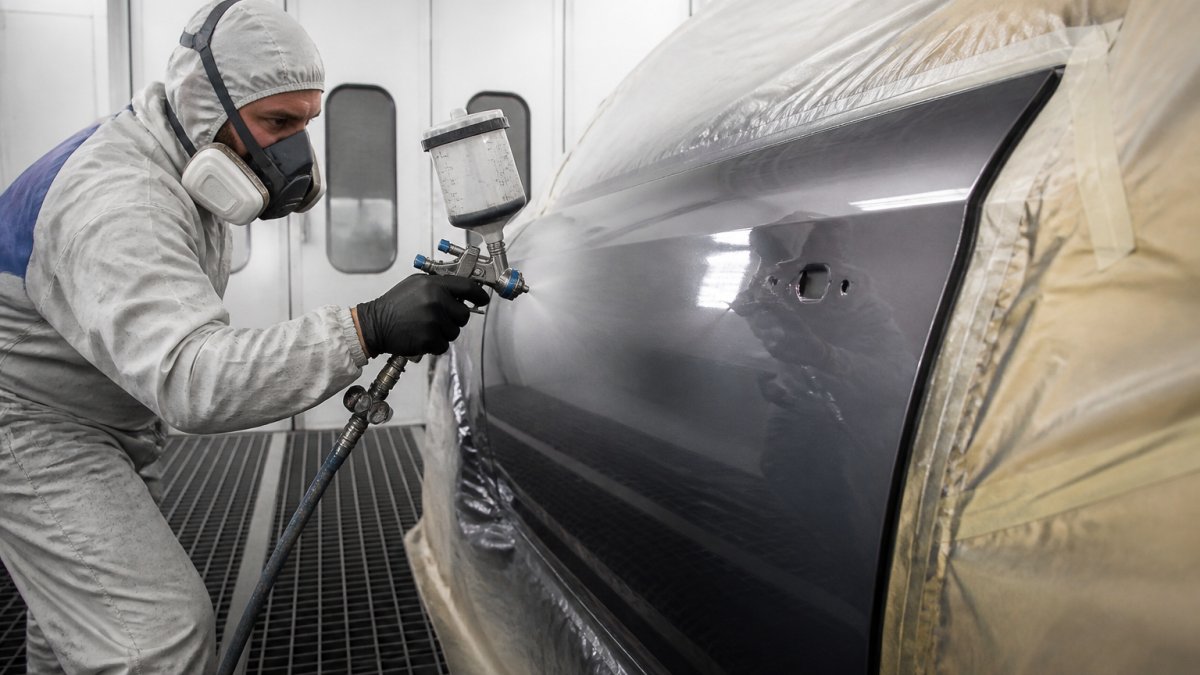
Spraying automotive paint is a repeatable process: mix to the data sheet ratio, test the pattern, apply thin overlapping coats, and respect flash time between them. Rushing any step shows up in the finish.
- Set up your space. Ventilate, mask the vehicle, and lay down drop cloths.
- Mix per the data sheet. Use graduated cups and the exact ratio.
- Test the gun pattern on scrap panel or masking paper.
- Apply a tack coat, a light pass to promote adhesion.
- Build coverage in thin coats, overlapping 50% each pass.
- Respect flash time between coats. Don't rush the next pass.
- Let it cure for the full time before sanding or polishing.
Mixing Ratios, Flash Time, and Recoat Windows
Mixing ratio is the paint-to-activator or paint-to-reducer proportion the manufacturer specifies, and it's not negotiable. Flash time is how long a coat must sit before the next one. The recoat window is the period during which the next coat will bond properly. Miss the window and you may need to sand before continuing. Every one of these numbers lives on the technical data sheet, so read it before you mix anything.
Safety, Ventilation, and Protective Equipment
Safety is the gap most beginner guides skip entirely. Automotive paints and clearcoats contain isocyanates and solvents that damage lungs and skin with repeated exposure. A dust mask is not enough.
Non-negotiables:
- Respirator rated for organic vapor and isocyanates, fit-tested
- Nitrile gloves and long sleeves, changed when contaminated
- Eye protection at all times while spraying
- Forced ventilation moving air across the work area and out
- No open flames or sparks, including water heaters and grinders
If you're spraying in an attached garage, seal the door to the house and run exhaust air away from living space. A mobile refinisher working outdoors still needs respiratory protection, because overspray drifts back at you.
Troubleshooting Common Paint Defects
Most paint defects trace back to one of four causes: wrong viscosity, wrong temperature, contaminated surface, or impatience. Diagnose by cause, not by symptom.
- Orange peel: texture from paint that's too thick or pressure that's too low. Thin per the data sheet and adjust the gun.
- Runs and drips: too much material in one pass. Slow down the coat, not the gun speed.
- Dry spray: reducer too fast for the temperature. Switch to a slower reducer.
- Fish eyes: silicone or oil contamination. Clean the panel and your gun.
- Blushing: moisture in the air line. Add a filter and drain the compressor.
The fix for most of these is a sanding pass and another coat, which is why buying a little extra paint is cheaper than running short.
Realistic Project Costs and Quantity Planning
Professional-grade paint costs more per quart than consumer product, but the real budget question is quantity and total system cost. Running short mid-job means a color mismatch on the next batch, and buying only the paint while forgetting consumables and equipment is the most common budget surprise for beginners. This section gives you a planning framework rather than a single price, because actual costs vary by system, color, and supplier.
Itemized Budget Categories
Build your budget in five lines, not one:
- Paint system: primer, color (basecoat or single-stage), reducer or activator, and clearcoat if using two-stage. Buy these as a matched system from one supplier so the chemistry is compatible.
- Surface prep and consumables: sandpaper in multiple grits, wax and grease remover, tack cloths, masking tape, masking paper, plastic sheeting, and mixing cups. These often add 15-25% to the paint line item and are frequently forgotten.
- Spray equipment: gun, compressor (if not already owned), hose, filters, and cleaning supplies. If you are buying equipment for a single project, factor in whether you will use it again.
- Personal protective equipment: respirator, cartridges, gloves, eye protection, and protective clothing.
- Contingency: add 20-30% for test spraying, mistakes, and a second batch if you run short.
Paint-Volume Estimates by Project Size
Exact coverage depends on the product's technical data sheet, film build, and spray technique, but these planning ranges are common in refinishing practice:
- Single panel (door, fender, hood): typically 1 quart of ready-to-spray color for a panel with jambs and edges, plus primer and clearcoat if two-stage. A quart of basecoat often covers one to two panels depending on color and technique.
- Multiple panels or a partial respray: plan by panel count. A common pattern is roughly 1 gallon of ready-to-spray product for a full vehicle exterior in a solid color, with more for metallics or three-stage finishes.
- Full vehicle: a gallon of color plus a gallon of clear is a common starting estimate for a full exterior respray, but always confirm against the data sheet and add 20-30% for test spraying and mistakes.
Count every panel being painted, including jambs, edges, and the underside of hoods and trunks, because those areas consume material and are easy to overlook. Buy primer, color, reducer or activator, and clearcoat as a matched system so the recoat windows and chemistry align.
Where Costs Escalate
- Color type: metallics, pearls, and three-stage finishes cost more per volume and require more careful application than solid colors.
- Equipment gaps: if your compressor cannot deliver the gun's CFM requirement, you may need to upgrade before you can spray at all.
- Workspace fixes: ventilation, lighting, and dust control are often the largest hidden costs for a home garage setup.
- Mistakes: runs, dry spray, and contamination each cost a sanding pass and sometimes another coat, which is why contingency matters.
Pricing depends on quantity, dates, and delivery, so check Speedokote's website for current pricing or a quote before you order.
Frequently Asked Questions
What is the easiest automotive paint for a beginner to spray?
Single-stage paint is the most forgiving option for a first-time painter. It combines color and gloss in one product, so you skip the separate clear-coat application that causes runs and uneven finish for most beginners. Single-stage kits from brands like Paint for Cars are marketed as easy to spray and fast drying, and Car Craft notes that single-stage dries glossy without a clearcoat. Fewer coats and fewer mixing steps mean fewer chances to make a mistake.
Is single-stage or basecoat-clearcoat better for beginners?
Single-stage is better for a first project. Basecoat-clearcoat gives deeper gloss and better weather resistance, but it requires two separate spray sessions with correct flash time and recoat windows between them. A beginner who gets the clear coat wrong ends up with orange peel or drips that need sanding and polishing. Start with single-stage on a smaller panel or a project car, then move to two-stage once your gun control is consistent.
What supplies do beginners need to paint a car?
At minimum you need primer, the paint kit itself, a compatible reducer or activator, sandpaper in several grits, tack cloths, masking tape and paper, a respirator rated for organic vapors, and a spray gun. An HVLP spray gun with a 1.3 to 1.4 mm tip handles most automotive paints. A detail or touch-up gun helps for small areas. Add a mixing cup with ratio markings, a paint strainer, and a clean, ventilated workspace before you start.
Can a beginner get professional results with automotive paint?
Yes, with realistic expectations. Universal Technical Institute describes automotive painting as complex, involving different paint types and their proper uses, so the learning curve is real. Maaco points out that professional refinishing includes surface preparation, precise mixing, and spray-booth application to eliminate contaminants. A beginner can match that finish quality by working in a clean, ventilated space, mixing to the exact ratio, and applying thin coats instead of heavy ones. Practice on a scrap panel first.
Do you need a primer before applying automotive paint?
Primer is required on bare metal, body filler, and sanded areas where the original finish has been removed. It gives the topcoat something to bond to and fills minor scratches. Skip primer only when you are spraying over a fully cured, intact factory finish that has been scuffed and cleaned. For a beginner painting a car body, motorcycle, or repaired panel, a primer coat is the step that prevents peeling and uneven color.
How many coats of automotive paint should a beginner apply?
Plan on two to three coats of color, applied as medium-wet passes rather than heavy ones. Each coat should flash off according to the product data sheet before the next one goes on. Three coats give better coverage and depth on a single-stage job. If you are spraying basecoat-clearcoat, follow two or three color coats with two or three clear coats. More thin coats beat fewer thick coats every time, because thick coats cause runs and solvent pop.
What safety equipment is needed when spraying automotive paint?
Use a respirator rated for organic vapors, not a dust mask. Automotive paints and reducers release isocyanates and solvents that a paper mask will not stop. Add nitrile gloves, eye protection, and a protective suit or long sleeves. Spray in a ventilated space with airflow moving away from you, and keep ignition sources out of the area. Check the product safety data sheet for the specific paint you buy before you open the can.
A first paint job fails on preparation and quantity planning far more often than on technique. If you want professional-grade materials without the guesswork, Speedokote supplies primers, single-stage and basecoat-clearcoat systems, spray equipment, and protective coatings from one mobile refinish source, with the service to match the products. Join our mailing list to get restock alerts, technical tips, and new product announcements before your next project starts.
