

Last Updated: October 30, 2026
Quick Summary
A professional auto body shop supply list covers fillers, primers, abrasives, masking materials, and safety gear, plus spray guns, mixing supplies, and solvents. Build your auto body shop supply list around what you use daily and keep backups of anything that stops a job cold.
- Buy abrasives by the box, not the sheet, so a Friday shortage doesn't cost half a day.
- Set minimum stock at what you need to finish two average jobs and maximum at four to six weeks of usage.
- Log consumables against each repair order rather than against the month to spot fast-vanishing products.
- Set gun pressure with a gauge at the gun, not at the compressor, because line loss misleads painters.
- Count fillers, primers, and sealers weekly and check solvent and reducer levels monthly.
Table of Contents
- Core Supplies Every Professional Auto Body Shop Supply List Needs
- The Auto Body Repair Tools List: Power Tools, Hand Tools, and Spray Equipment
- Automotive Paint Shop Supplies: What Belongs in the Paint Room
- Collision Repair Shop Inventory Management That Prevents Backorders
- Your Auto Body Shop Inventory Checklist for Weekly and Monthly Counts
- Stocking Your Shop Through a Mobile Refinish Supplier
- Frequently Asked Questions
Core Supplies Every Professional Auto Body Shop Supply List Needs
A professional auto body shop supply list is the working inventory that keeps a bay productive: fillers, primers, abrasives, masking materials, and safety gear. Get these wrong and every repair slows down. The U.S. auto body shops industry is a $67.7 billion market in 2026, according to IBISWorld's Auto Body Shops in the US Industry Analysis, and shops that run out of consumables mid-job feel it in cycle time.
At Speedokote, we build supply lists around one rule: stock what you touch every day, and keep a backup of what stops a job cold.
Body Fillers, Primers, and Abrasives
Fillers and primers do the structural and cosmetic work. Abrasives make both possible.
- Body filler and glazing putty for dent filling and pin-hole work
- Epoxy and urethane primers for bare metal and plastic adhesion
- Sandpaper grits from 80 for stripping to 600+ for finish prep
- Sandpaper backing pads and blocks to keep edges flat
- Abrasive discs, strips, and rolls in the sizes your tools take
Buy abrasives by the box, not the sheet. A shop that runs out of 180-grit on a Friday afternoon loses half a day.
Safety and Masking Consumables
Safety gear protects your painters. Masking materials protect the car.
- Nitrile gloves, safety glasses, and respirator cartridges
- Paint suits and shop towels
- Masking tape in 1/4-inch, 3/4-inch, and 2-inch widths
- Masking paper, plastic sheeting, and foam tape for jambs
- Tack cloths and surface prep wipes
Watch out: skipping fresh respirator cartridges to save a few dollars is the most common shortcut in this category, and it is the one that costs the most.
The Auto Body Repair Tools List: Power Tools, Hand Tools, and Spray Equipment
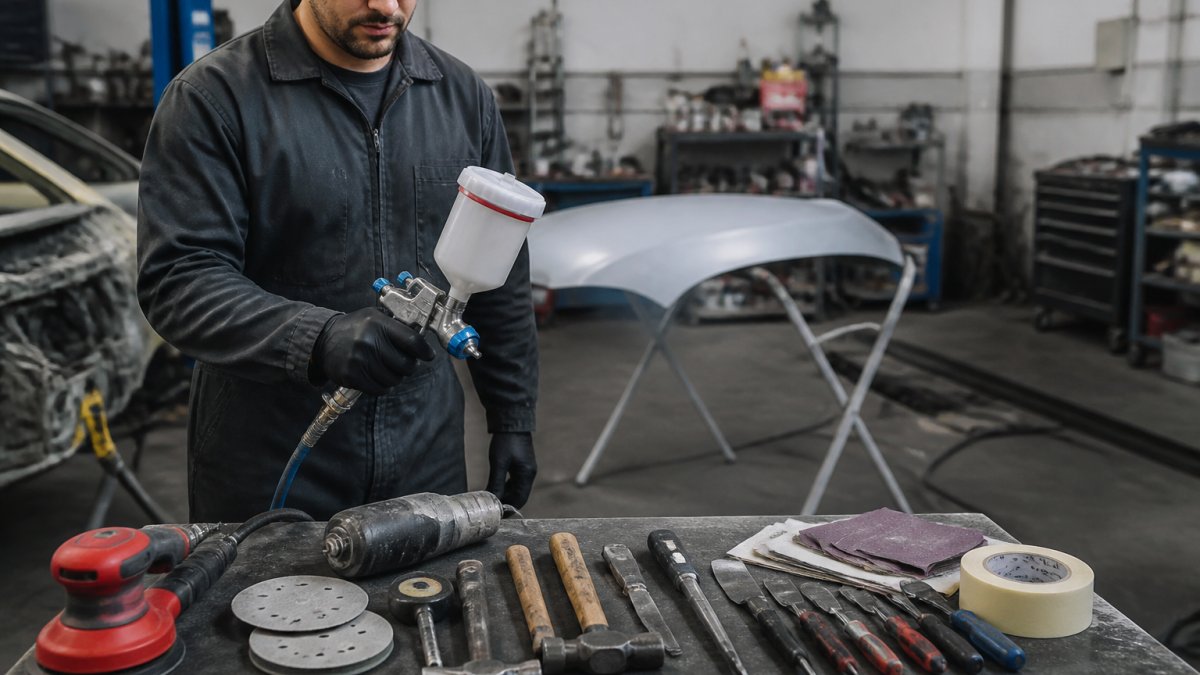
An auto body repair tools list splits into three groups: power tools that remove material, hand tools that shape it, and spray equipment that finishes it. Most shops already own the first two. The third is where quality shows up in the final coat.
Spray Guns and Compressor Setup
- HVLP spray guns for primer, base, and clear
- A dedicated primer gun so you never contaminate topcoat
- Compressor with moisture traps and filters to keep water out of the line
- Air hose, fittings, and a regulator at the gun
- Gun cleaning kit and solvent for between coats
Set gun pressure with a gauge at the gun, not at the compressor. Line loss fools more painters than any other variable.
Automotive Paint Shop Supplies: What Belongs in the Paint Room
Automotive paint shop supplies cover everything that touches mixed paint: cups, strainers, mixing sticks, and solvents. The average body shop repair order reached $1,264 in the first half of 2026, per BodyShop Business reporting on rising repair orders. More expensive repairs mean less room for a botched mix.
- Graduated mixing cups in multiple sizes
- Paint strainers and filters
- Stir sticks and mixing boards
- Reducer, thinner, and gun wash
- Color matching chips and spray-out cards
- Sealer, basecoat, and clearcoat in your shop's core colors
Keep a spray-out card for every color you mix. It settles blend disputes fast.
Collision Repair Shop Inventory Management That Prevents Backorders
Collision repair shop inventory management is the practice of setting stock levels and tracking usage so a job never waits on a part or a can of primer. It is the difference between a smooth week and a Friday scramble.
Set Minimum and Maximum Stock Levels
Every line item needs a floor and a ceiling. Set the minimum at what you need to finish two average jobs. Set the maximum at four to six weeks of usage. When stock hits the minimum, reorder to the maximum.
Track Usage by Repair Order
Log consumables against each repair order, not against the month. You will spot the products that vanish faster than expected, and the ones sitting on the shelf past their shelf life. A simple spreadsheet beats a guess every time.
Your Auto Body Shop Inventory Checklist for Weekly and Monthly Counts
An auto body shop inventory checklist turns stock control into a routine instead of a crisis. Here is the checklist we recommend:
- Count fillers, primers, and sealers weekly
- Check abrasive stock against the last two weeks of usage
- Verify masking tape and paper levels before the weekend
- Inspect respirator cartridges and glove stock
- Check solvent and reducer levels monthly
- Review spray gun condition and cleaning logs
- Flag anything within one week of the minimum level
| Item Group | Count Frequency | Reorder Trigger |
|---|---|---|
| Fillers and primers | Weekly | At two-job minimum |
| Abrasives | Weekly | Two weeks of usage left |
| Masking supplies | Weekly | One week of stock left |
| Solvents and reducers | Monthly | Half-container level |
| Safety gear | Monthly | One box remaining |
The Occupational Safety and Health Administration sets the respiratory protection rules that govern cartridge changes, so build those replacements into the same count.
Stocking Your Shop Through a Mobile Refinish Supplier
A mobile refinish supplier brings the supply room to your bay, which cuts the ordering guesswork out of the list above. Speedokote stocks fillers, primers, clearcoats, spray equipment, and protective coatings.
Frequently Asked Questions
What supplies does a professional auto body shop need?
A working supply list covers four groups: body fillers, primers, and abrasives; power and hand tools such as DA sanders, dent pullers, and spray guns; paint room items including base coats, clearcoats, reducers, and mixing cups; and safety and masking consumables like respirators, gloves, and masking film. A missing item in any of these groups can stall a high-value job.
What tools are essential for an auto body repair tools list?
Start with a dual-action sander, a spray gun, a dent puller, a body hammer and dolly set, a die grinder, and a quality air compressor sized to your gun. Add measuring and alignment tools if you handle structural work. Buy professional-grade versions of the tools you use daily; a cheap DA sander that dies mid-job costs more in downtime than the price difference. Keep a backup gun and sander on the shelf so one failure never stops a bay.
How should an auto body shop organize its supplies?
Group supplies by workflow stage rather than by product type: body prep, paint room, and finishing. Label shelves with minimum stock levels, keep a printed auto body shop inventory checklist at each station, and store paint materials in a temperature-controlled room away from dust. Assign one person to place orders and log deliveries. This setup supports collision repair shop inventory management and makes weekly counts fast enough that staff actually do them.
How often should a body shop restock paint and repair materials?
Count high-use consumables weekly and full inventory monthly. Set reorder points based on your busiest two-week stretch, not your average, so a run of large jobs does not empty the shelf. Order primers, clearcoats, and abrasives before they hit the reorder point, and confirm lead times with your supplier in writing. Confirm stock availability of specialty primers and clearcoats with your supplier before you need them. For current pricing and availability, visit the Speedokote website or request a quote.
Running a shop means every hour of downtime has a cost, and a missing consumable is the easiest one to prevent. Speedokote supplies professional-grade fillers, primers, clearcoats, spray equipment, and protective coatings, backed by a team that answers when you call. Join our mailing list to get supply planning tips and product updates from Speedokote.
