
Last Updated: November 4, 2026
Quick Summary
The best mobile refinishing coatings are professional-grade ceramic coatings with controlled flash time, plus fast-cure acrylic urethane clearcoats that release the vehicle the same day. Match each product to surface temperature, humidity, and fresh-paint recoat windows rather than spraying one coating in every condition.
- Keep one fast-cure clear for same-day releases and one standard clear for finish quality.
- Surface temperature, not air temperature, governs cure and must be measured before spraying.
- A portable pop-up booth, shade, and a surface-temperature gauge are the minimum kit.
- Epoxy primers seal best but need longer flash time; urethane primers cure faster in cool weather.
- The U.S. automotive refinish coatings segment is forecast at $231.7 million in 2025.
Table of Contents
- Best Professional Ceramic Coating for Cars in a Mobile Setup
- Automotive Clearcoat for Mobile Refinishing: Fast Cure, Field-Ready
- Automotive Primer for Mobile Repair: What Holds Up Outdoors
- Automotive Coating Application Temperature and Humidity Limits
- Frequently Asked Questions
Best Professional Ceramic Coating for Cars in a Mobile Setup
The best mobile refinishing coatings depend on cure speed in the field, compatibility with fresh paint, and control over temperature and humidity. At Speedokote, we supply mobile refinishers who cannot afford a coating that flashes too fast in the sun or fails to bond in a cold garage. A 2025 review of car coating materials examined wax, ceramic, graphene, and hybrid formulations but found no single category wins across all conditions (Development of Car Coating Materials over the Past Decade).
For mobile work, a professional-grade ceramic coating with controlled flash time is generally preferable to a consumer spray.
| Coating | Price | Cure Profile | Best For |
|---|---|---|---|
| Chemical Guys Carbon Force | $130 | Slow, technique-sensitive | High-gloss premium jobs |
| Adam's Graphene Spray | $45 | Fast spray-on, wipe-off | Quick mobile turnarounds |
| Gtechniq Crystal Serum Light | $85 | Moderate, pro-grade | Balanced durability |
| Turtle Wax Hybrid Solutions | $18 | Instant | Maintenance washes |
Best for: detailers who control the environment. Skip if: you are coating in direct sun with no shade.
Automotive Clearcoat for Mobile Refinishing: Fast Cure, Field-Ready
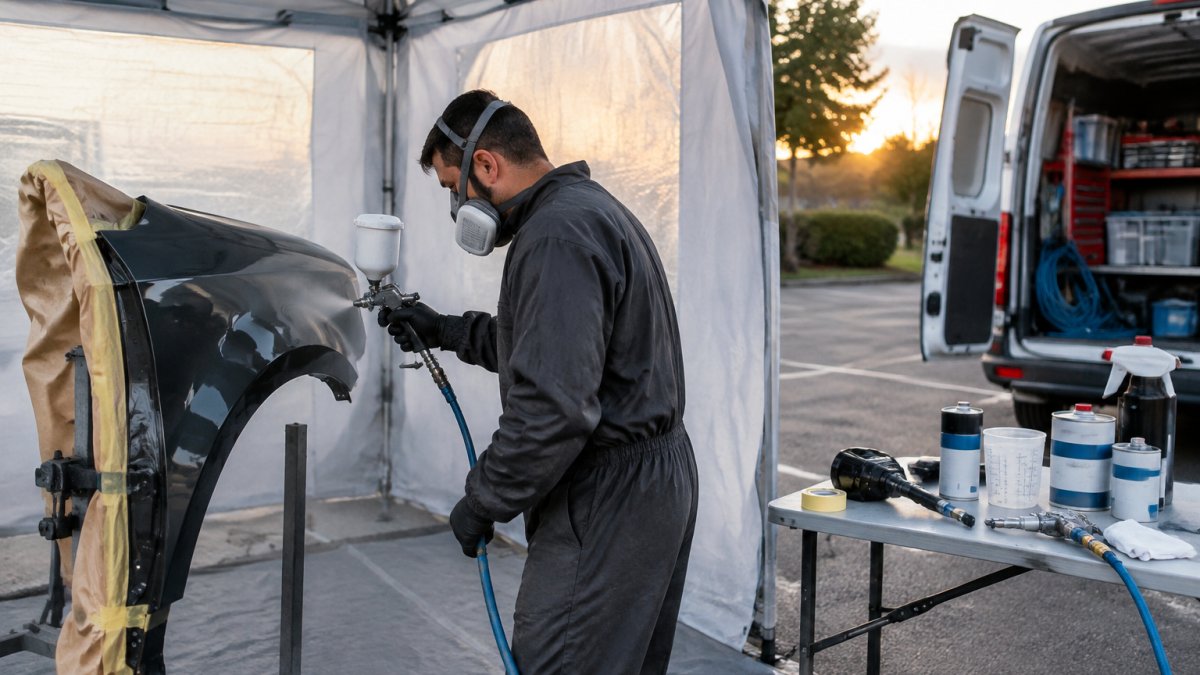
Automotive clearcoat for mobile refinishing must cure fast enough to release the vehicle the same day while resisting dust, wind, and temperature swings a booth would block.
Fast-cure versus standard-cure clearcoat
Fast-cure acrylic urethane clearcoats use accelerated catalysts and shorter flash windows, so a panel is handleable far sooner than with standard two-component clear. Standard-cure clears offer longer open time, better flow-out, and more forgiving buffing, but tie up the vehicle longer. Keep one fast-cure clear for same-day releases and one standard clear where finish quality outweighs turnaround.
Fresh-paint compatibility and cure windows
Clearcoat over fresh refinish work must respect the repair system underneath. Solvent-borne clears need the basecoat properly flashed and, in many systems, primer and sealer within the manufacturer's recoat window. Spraying over a basecoat still off-gassing traps solvent, causing solvent pop, die-back, or delamination, often after the vehicle has left. Follow the repair system's data sheet rather than a generic cure time, because flash and recoat windows shift with temperature and film build.
Field conditions that change the cure
Surface temperature, not air temperature, governs cure. A dark panel in direct sun can run well above ambient, shortening flash and risking solvent pop; a cold panel can sit below the clear's rated minimum and never crosslink. High humidity causes blushing, and wind carries dust into wet film and accelerates skin-over, trapping solvent. A portable pop-up booth, shade, and a surface-temperature gauge are the minimum kit.
Equipment and setup for mobile clearcoat
Mobile clearcoat work is an equipment problem as much as a product problem. A portable HVLP or LVLP gun paired with a compressor sized to the gun's CFM demand keeps atomization consistent; undersized air causes orange peel and uneven film build.
Job economics and rework risk
Clearcoat is where mobile jobs make or lose money. Material cost per job is modest compared with the labor tied up in a rework, so the cheapest clear per ounce is rarely the cheapest clear per job. A fast-cure product that releases the vehicle the same day frees the bay for the next job; a slow clear that forces an overnight hold costs schedule even when the material is cheaper. The MarketsandMarkets forecast for the U.S. automotive refinish coatings market puts the segment at $231.7 million in 2025, rising to $253.6 million by 2030 at 1.82% annual growth. Modest growth means shops compete on turnaround, not volume, so a clearcoat that protects your schedule protects your margin.
Best for: operators who match the clear to the job and measure surface temperature before spraying. Skip if: you spray one clear in every condition and hope the weather cooperates.
Automotive Primer for Mobile Repair: What Holds Up Outdoors
Automotive primer for mobile repair has to bond to bare metal and repaired panels without a climate-controlled booth. Epoxy primers seal best but need longer flash time; urethane primers sand easier and cure faster in cool weather.
Fresh paint compatibility matters most. A primer that lifts or reacts with the repair system underneath means a full rework. The DAR-Tech automotive coatings production-sequencing case study reported 92% material cost savings and a 77% reduction in production time from better sequencing, which shows how much process discipline affects the bottom line. Mobile work rewards the same discipline: match primer to substrate, respect flash windows, and never topcoat before the primer is fully cured.
- Confirm substrate: bare metal, plastic, or existing finish
- Check primer's rated temperature and humidity range
- Verify flash time before topcoat
- Test-spray a small panel first
Automotive Coating Application Temperature and Humidity Limits
Automotive coating application temperature and humidity limits decide whether a job succeeds before you ever pick up the gun. Most refinish coatings specify a surface temperature range and a maximum relative humidity; step outside either and adhesion, gloss, and cure suffer.
Mobile refinishing coatings face wind-borne dust, direct sun, and cold mornings that a booth eliminates. The fix is portable: pop-up booths, shade, and a hygrometer to read conditions on site. The global refinish coatings market is projected to grow from USD 9.0 billion in 2026 to USD 15.1 billion by 2036 at 5.3% annual growth (Future Market Insights automotive refinish coatings forecast), and field-ready products are where that growth lands.
Best for: operators who measure conditions before spraying. Skip if: you spray by feel and hope.
Frequently Asked Questions
Can automotive coatings be applied outdoors or in a mobile shop?
Yes, but the coating has to match the conditions. Field work exposes wet film to wind-borne dust, sun, and shifting humidity, so mobile refinishers should favor fast-flash clearcoats and spray-applied ceramic or graphene products that tolerate a wider application window. A pop-up booth or canopy cuts contamination risk. Check the product data sheet for the manufacturer's stated temperature and humidity range before you spray, and avoid applying in direct sun or gusting wind.
How do temperature and humidity affect automotive coating application?
Temperature and humidity control how fast a coating flashes, cures, and bonds. Cold slows cure and can leave a soft film; high heat speeds flash time and raises the risk of solvent popping or dry spray. High humidity interferes with moisture-sensitive products like some clearcoats and primers. Follow the data sheet range for each product, and measure surface temperature, not just air temperature, since a panel in direct sun runs hotter than the surrounding air.
Which automotive clearcoat works best for mobile refinishing?
Look for a clearcoat with a short flash time and a forgiving recoat window, since a mobile job can't always wait for ideal conditions. Two-component urethane clearcoats designed for spot and panel repair are the usual pick. Confirm compatibility with the primer and base coat already on the vehicle, and check the data sheet for the minimum and maximum application temperature. Speedokote's catalog covers a wide selection of professional automotive refinish brands; check the website for current product availability.
Mobile refinishing rewards preparation over guesswork. Speedokote stocks the primers, clearcoats, and protective coatings that hold up outdoors, backed by a commitment to full customer satisfaction and a wide selection of professional refinish brands. Get started with Speedokote and keep every mobile job field-ready from primer to final coat.
