

Last Updated: November 8, 2026
Quick Summary
Verify paint quality by inspecting in natural daylight or a controlled shop light held at a low angle, sighting down each panel's reflection line and comparing against an approved benchmark sample. Then take three to five paint thickness gauge readings per panel and document any defects in writing.
- Inspect panels crouching to eye level, viewing straight on and at a slant.
- Keep an approved test panel nearby and compare finished work against it.
- Watch for drips, sags, orange peel, brush marks, and thin missed spots.
- Take three to five gauge readings per panel and record each by panel name.
- Photograph every defect with the inspection light in frame and send the list in writing.
Table of Contents
- How to Inspect a Car Paint Job in the Right Conditions
- Spotting Automotive Paint Defects: Drips, Sags, and Orange Peel
- Using a Paint Thickness Gauge for Cars to Check Film Build
- Checking Car Paint Color Match Inspection and Coverage
- Documenting Defects and Requesting Corrections
- Frequently Asked Questions
How to Inspect a Car Paint Job in the Right Conditions
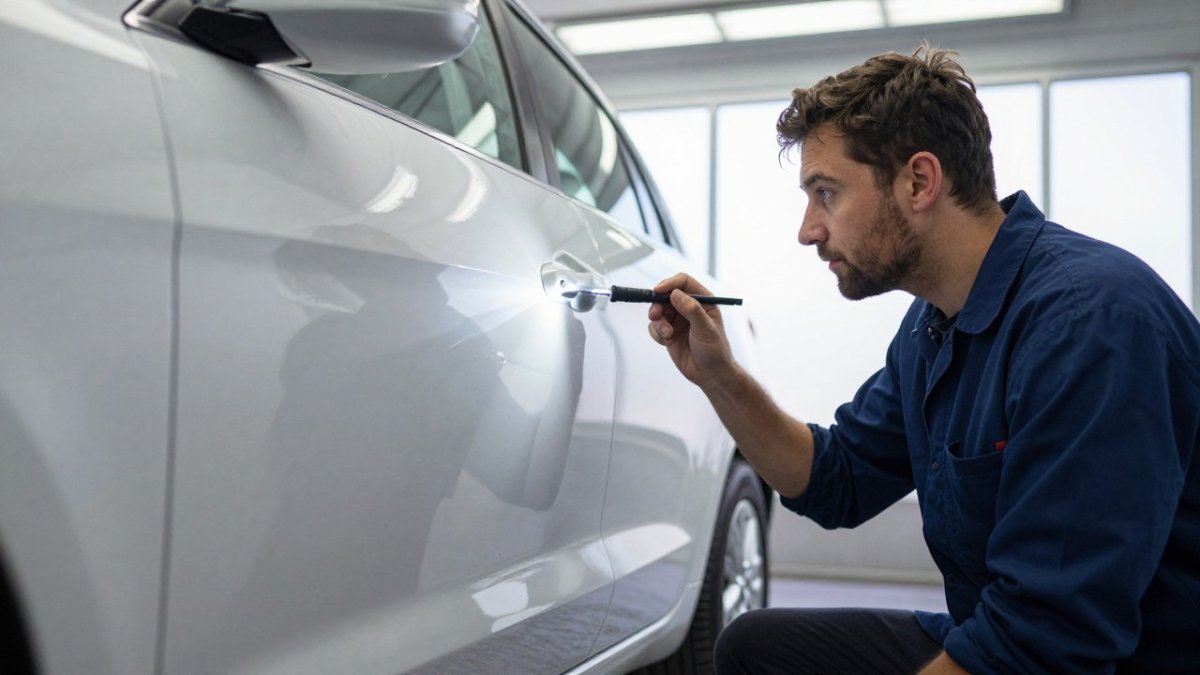
Verifying professional paint quality starts with one rule: you can't judge paint quality you can't see. Inspect in natural daylight or a controlled shop light held at a low angle, crouching to eye level and sighting down the reflection line on each panel, straight on and at a slant.
According to the Painting Contractors Association's P5 standard, a benchmark sample gives you a project-specific reference for judging finished work, keep an approved test panel nearby and compare against it.
Spotting Automotive Paint Defects: Drips, Sags, and Orange Peel
Automotive paint defects show up fast under the right light, run your eyes and a bare hand across each panel. Watch for drips and runs (teardrops frozen mid-slide under edges and trim), sags (heavier curtains that pooled before curing), orange peel (bumpy citrus-skin clearcoat), brush or roller marks, and thin missed spots where color looks washed out.
A visual inspection alone won't always explain a failure. The paint failure investigation guidance from BBB Technologies notes that a proper review can require purchase orders, inspection reports, technical data sheets, and physical samples. Document what you see before you call it a defect.
Using a Paint Thickness Gauge for Cars to Check Film Build
A paint thickness gauge for cars measures film build in mils and is the fastest way to prove coverage: wild swings across one panel mean uneven application, and thin readings mean a coverage problem. Take three to five readings per panel, record each next to the panel name, and flag any panel where the numbers jump or drop sharply against your benchmark.
The U.S. Environmental Protection Agency has studied how to measure paint emissions and evaluate paint effects on indoor air quality, which matters when you're spraying in an enclosed bay. Good film build and a clean booth go together.
A thickness gauge turns film build into numbers you can record and compare against your benchmark.
| Item | Value | Note |
|---|---|---|
| What the gauge measures | Film build in mils | Fastest way to prove coverage |
| Readings per panel | Three to five | Record each next to the panel name |
| Uneven application sign | Wild swings across one panel | Indicates uneven application |
| Coverage problem sign | Thin readings | Means a coverage problem |
| Panels to flag | Numbers jump or drop sharply | Compare against your benchmark |
Checking Car Paint Color Match Inspection and Coverage
Check color match in daylight rather than under sodium shop lamps: hold a color card against each panel and step back three feet. Watch for panels that shift tone as you walk around the car, metallic flake laying differently on a door versus a fender, and visible blend lines at edges, uneven overlaps and thin coverage both read as a color mismatch.
Documenting Defects and Requesting Corrections
Photograph every defect with the inspection light in frame, write down the panel, defect type, and date, then send the list to the shop in writing and ask for a correction timeline. Follow up in person with the same light and viewing angle; corrections should match the benchmark sample.
Spotting a bad finish is one thing. Preventing it starts with the right materials. Speedokote supplies professional-grade primers, clearcoats, and spray equipment to shops that care about film build and color consistency. Our mobile refinish supply service keeps your bay stocked so a thin panel never reaches the customer. Get started with Speedokote and inspect every job against a finish you can trust.
Frequently Asked Questions
How can you check the quality of a professional automotive paint job?
Start with the conditions: inspect in natural daylight or a controlled inspection light, at multiple viewing angles, and check the reflection line across each panel. Look for consistent color and coverage, no brush or roller marks, no drips, runs, or sags, and clean edges at trim and jambs. A visual inspection alone may not establish coating quality, so back it up with a paint thickness gauge for cars and a color match check under natural light. Using an approved benchmark sample as a reference for achievable quality is a sound approach.
What should you inspect before accepting a car paint job?
Work panel by panel. Check color consistency and coverage, finish uniformity, surface smoothness, and edging lines at corners and trim. Confirm that patch work and surface repairs are invisible under raking light. Measure film build with a paint thickness gauge for cars and compare readings across panels. If you find defects, document them with photos, panel location, and the lighting conditions, then request corrections in writing before signing off. Keep purchase orders and product technical data sheets on file.
Can a paint thickness gauge for cars verify the quality of a repaint?
It verifies film build, not the whole finish. A gauge shows whether paint thickness in mils or microns is consistent across panels and within the coating system's expected range. Uneven readings can point to uneven overlaps, missed spots, or excessive material. Pair the readings with a visual and tactile inspection for drips, sags, and surface smoothness. A paint failure investigation may also require records and physical samples, since a visual inspection alone may not explain a defect.
