

Last Updated: November 2, 2026
Quick Summary
The best automotive spray equipment for pros is defined by fluid tip size, CFM, and transfer efficiency. Match the tip to the coating (1.4 mm for base and clear, 1.7-2.0 mm for primer), match CFM to your compressor at 25-30 PSI, and choose HVLP for transfer efficiency.
- Check compressor output before buying a gun, since an undersized compressor causes sputtering no tip adjustment can fix.
- Daily-production HVLP setups run a 1.4 mm nozzle, 600 cc cup, and stainless passages.
- A mid-tier repairable gun costs less over a year than replacing a bargain gun twice.
- Two correctly sized guns beat one stretched across primer, base, and clear.
- A kit only works when the compressor's CFM at working pressure exceeds the gun's demand.
Table of Contents
- What Pros Need in Automotive Spray Equipment
- Best HVLP Spray Gun Automotive Setups for Consistent Atomization
- Best Automotive Paint Gun for the Money: Where Budget Meets Durability
- Professional Automotive Paint Spray Guns: Matching the Gun to the Job
- Automotive Spray Gun Kit with Compressor: System Cost and Compatibility
- Base Coat, Clear Coat, and Primer: Coating-Specific Setup
- Durability, Repairability, and Operating Costs
- Choosing Your Setup: A Decision Guide by Job and Volume
- Frequently Asked Setup Questions
- Frequently Asked Questions
What Pros Need in Automotive Spray Equipment
The best automotive spray equipment for pros is defined by fluid tip size, CFM, and transfer efficiency.
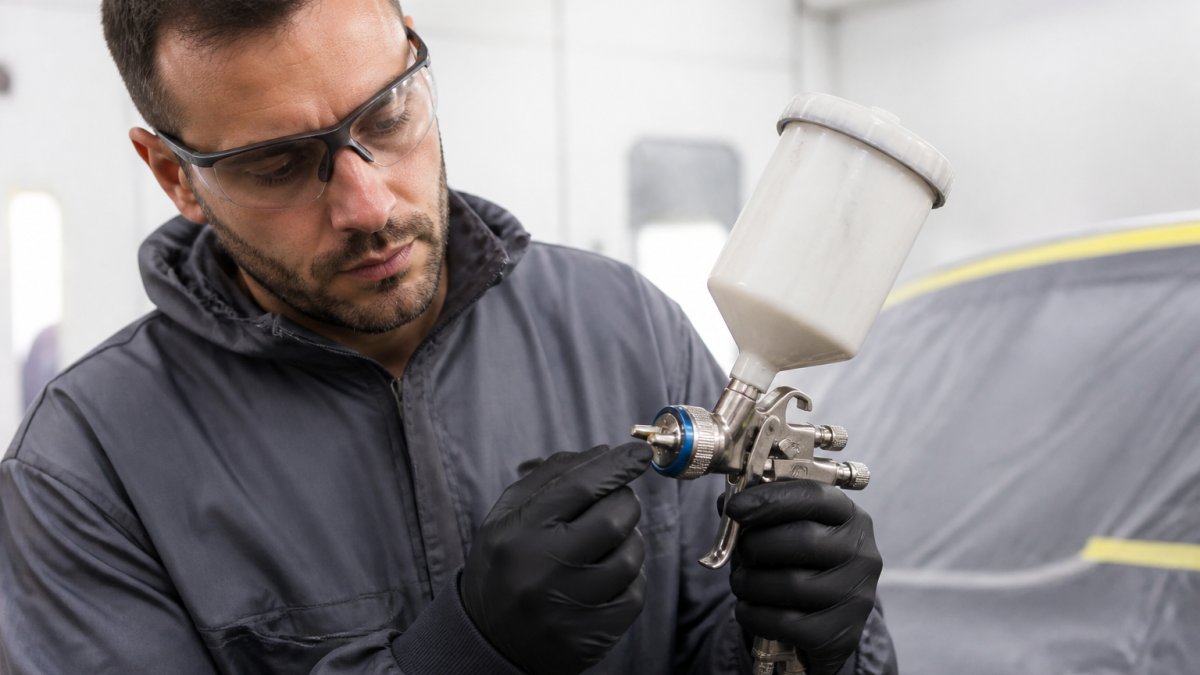
Match tip to coating (1.4 mm for base/clear, 1.7-2.0 mm for primer), match CFM to your compressor at 25-30 PSI, and choose HVLP for transfer efficiency. Read OSHA ventilation guidance for spray operations before setting up any booth.
| Spec | Base Coat / Clear Coat | Primer / High-Build |
|---|---|---|
| Fluid tip | 1.4 mm | 1.7 mm to 2.0 mm |
| Working pressure | 25-30 PSI at gun | 25-30 PSI at gun |
| Fan width | 8-12 inches | 10-14 inches |
Best HVLP Spray Gun Automotive Setups for Consistent Atomization
Consistent atomization comes from a gravity-feed HVLP gun with a matched fluid tip, clean air, and a regulator at the gun; daily-production setups run a 1.4 mm nozzle, 600 cc cup, and stainless passages. Atomization problems usually trace to dirty air, add a coalescing filter and drain the compressor regularly.
Best Automotive Paint Gun for the Money: Where Budget Meets Durability
The best automotive paint gun for the money balances repairable parts with a body that survives daily cleaning; a mid-tier gun with replaceable needle, nozzle, and seal kits costs less over a year than replacing a bargain gun twice. Standardize on one repairable model across painters; mobile refinishers should choose a compact gravity-feed gun with a smaller cup.
Professional Automotive Paint Spray Guns: Matching the Gun to the Job
Choose professional automotive paint spray guns by job type and volume, not catalog ranking.
| Job Type | Gun Configuration | Why It Fits |
|---|---|---|
| Spot and panel repair | Compact gun, 1.4 mm tip, small cup | Light, fast cleanup, easy control |
| Full-car base and clear | Full-size gravity-feed, 1.4 mm tip | Even fan, consistent coverage |
| Primer and surfacer | Full-size gun, 1.7-2.0 mm tip | Handles higher-viscosity material |
Buying one premium gun for primer, base, and clear fails: primer clogs a 1.4 mm tip, clear floods a 2.0 mm tip. Two correctly sized guns beat one stretched across every coating.
Automotive Spray Gun Kit with Compressor: System Cost and Compatibility
An automotive spray gun kit with compressor only works when the compressor's CFM at working pressure exceeds the gun's demand, most kit failures are air-supply failures. Check rated CFM at 40 PSI against gun consumption, and budget for a regulator, coalescing filter, hose, fittings, and cleaning supplies; skipping filtration costs more in rework. EPA information on refinish coatings and VOC rules matters if you spray commercially.
Base Coat, Clear Coat, and Primer: Coating-Specific Setup
Pros who spray all three daily keep dedicated guns: base coat needs fine atomization, clear coat a slightly wider fan, and primer a larger fluid tip. Flush with the correct solvent between coatings, clean the air cap passages, and lubricate moving parts per the manual.
Durability, Repairability, and Operating Costs
Operating cost, not purchase price, separates a professional gun from a budget one. Ask whether a rebuild kit is available and what it costs relative to a new gun; stainless passages resist solvent, machined air caps hold pattern longer, and metal bodies survive drops. Buy the repairable tier for any gun used more than a few times a month.
Choosing Your Setup: A Decision Guide by Job and Volume
Use this guide to pick a configuration. Pricing depends on configuration, quantity, and delivery, check our site or request a quote. A short call about your compressor and coatings saves a costly mismatch.
Frequently Asked Setup Questions
A 1.4 mm fluid tip is the standard starting point for clear coat; adjust fluid and air to the coating's viscosity and manufacturer's spec.
Yes, in most professional shops.
Match the compressor's CFM at working pressure to the gun's rated consumption with margin to spare; undersized air causes sputtering and uneven fan patterns.
Inspect seals regularly and replace them at leaks, spitting, or inconsistent patterns. Keep a rebuild kit on hand to prevent downtime.
Frequently Asked Questions
What should professionals look for in automotive spray equipment?
Start with the gun's transfer efficiency and how well it atomizes your coatings. HVLP guns with gravity-feed cups and a 1.4 mm nozzle suit most base coats, while a 1.7 mm or 2.0 mm fluid tip handles primers and heavier materials. Check air consumption in CFM against your compressor's output at the required PSI. Ergonomics and easy cleaning matter over long production days.
Do professional automotive paint spray guns require a specific compressor?
Yes. Each gun draws a set volume of air, measured in CFM, at a stated PSI. Undersized compressors cause pressure drop, poor atomization, and uneven finish. Match the gun's air consumption to your compressor's rated output at the working pressure, and add an air regulator and moisture trap at the gun.
What is the difference between HVLP and other automotive spray guns?
HVLP, or high-volume low-pressure, moves a large volume of air at lower pressure, which raises transfer efficiency and reduces overspray. Conventional air spray runs higher pressure for finer atomization but sends more material into the air. Compliant and reduced-pressure guns sit between the two. For base coat and clear coat work, HVLP is common because it keeps more paint on the panel and produces a smooth finish with less waste.
Matching gun, compressor, and coating correctly is the difference between a finish that holds up and a rework job that eats your margin. Speedokote supplies professional automotive refinish brands and the essentials around them, from fillers and primers to spray equipment and protective coatings, with service built for collision shops and mobile refinishers alike. Get started with Speedokote and equip your shop with supplies chosen for the work you actually do.
